




Someone asked me this week, “Simone, you keep saying ‘live, don’t exist.’ How you actually do that?” I smiled, because the answer is not complicated, and it is rooted in the same fire that carried our people through sugar fields, storm seasons, and border crossings.
I am thinking of Florence Scovel Shinn’s The Game of Life and How to Play It, a slim book that feels like a grandmother whispering strategy in your ear. She says life is not a battle. It is a game, and games have rules. Most of us are playing blindfolded, reacting to every ping, every bill, every slight like it is the final boss. Our ancestors did not raise us to be NPCs in someone else’s script.
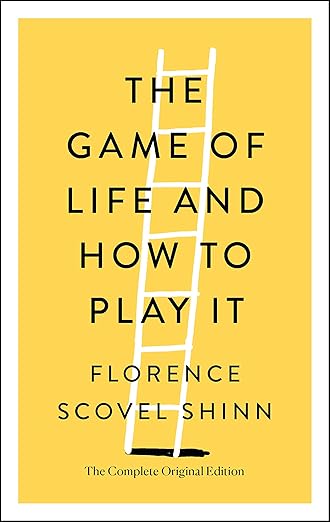
Photo Courtesy of Amazon
Here’s the first rule, what you sow in your mind, you reap in your reality. That is not woo-woo. That is neurobiology. Your brain is constantly scanning for evidence to confirm what you already believe. If you wake up telling yourself, “I’m tired, I’m stuck, I’m barely making it,” your System 1 (the fast, intuitive part of your mind) will find a thousand ways to prove you right. If you prime it with “I am here to play, to create, to leave something behind,” suddenly the same day looks different. The same obstacles become plot points, not full stops.
I grew up Caribbean, where survival was the baseline. Existence was the victory, but we were not meant to stop there. My mother did not cross oceans so I could exist in a cubicle, numbing out after 6:00 p.m. She crossed so I could live: fully, loudly, unapologetically. That means making choices that honour the life inside you, not just the obligations around you.
Shinn talks about the Law of Nonresistance; do not fight the current; redirect it. In Caribbean terms: do not curse the rain; learn to dance in it. When life hits you (and it will), you have got two options. You can resist and drown, or you can move with it and find the rhythm. That’s emotional intelligence in action: perceiving the emotion, understanding its message, and managing it so it serves you instead of enslaving you.

Living means feeling pain, naming it, and then asking, “What is this trying to teach me?” Fear is not your enemy; it is your scout. Frustration is feedback. Our people have always known this. We turned trauma into testimony, silence into song, oppression into art. That is strategy.
So how do you start? Small rebellions. Say no to one thing that drains you. Say yes to one thing that lights you up. Read a page. Walk ten minutes. Call someone who reminds you of who you are. These are acts of resistance against a system that profits from your exhaustion.
Here is the part most self-help skips: you don’t have to do it alone. Cialdini’s principle of social proof is real; we look to others to decide what is possible. Find your people. The ones who live loud. The ones who do not apologize for taking up space. Spend time with them. Let their energy recalibrate yours. You become who you spend time with.

Photographer: Reza Shahriari
Roy Peter Clark, in Writing Tools, says, “Place gold coins along the path.” Collect moments that feel like gold coins: laughter that cracks your ribs open, conversations that shift your axis, quiet mornings where you remember your own name.
The public is irrational. Most people can’t hold complexity. They rely on stereotypes, experts, shortcuts. So, make it simple. Make it sticky. Make it concrete. Tell yourself, “I am not here to exist. I am here to live.” Say it until your nervous system believes it.
Your ancestors survived for you to create, to love, to leave something behind that makes the next generation’s burden lighter. That is the game. That is the win.
Stay in the loop with exclusive news, stories, and insights—delivered straight to your inbox. No fluff, just real content that matters. Sign up today!