
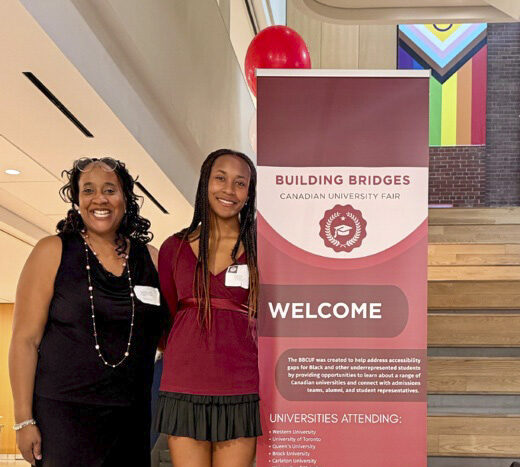

The foyer inside University of Toronto Schools buzzed with possibility on Saturday morning as hundreds of Black students and their families gathered for something unprecedented: a university fair designed specifically for them. The Building Bridges University Fair, organized by 15-year-old Grace Longe, represented a deliberate act of community healing through educational access.
“I go to Harperville, and at my school we have these types of things all the time,” Grace explained, her voice carrying the confidence of someone who refuses to accept inequality as normal. “I realize that my friends at other schools didn’t have that same kind of opportunity, as I go to a private school, so it’s definitely not the same in the public system.”
Grace’s observation reflects a stark reality: while private schools regularly host university recruitment events, students in public schools (particularly Black students) often lack access to the same opportunities. Her solution was characteristically direct: if the resources were not reaching her community, she would bring them together herself.
The event attracted representatives from across Ontario’s university landscape, including the University of Toronto, Carleton University, and the University of Ontario Institute of Technology. The fair specifically highlighted programs designed to remove barriers for marginalized students.
Abdullah, a University of Toronto recruitment coordinator, outlined numerous pathway programs available to Black students, including Blueprint, a free engineering summer program for Black students in Grades 10-11, and MedLinks, which introduces students to health sciences. “Each of these programs has a coordinator who goes directly to high schools to talk and give presentations,” he explained, though he acknowledged that awareness remains a challenge.
The gap Grace identified is supported by both statistics and lived experience. Multiple university representatives confirmed that, despite numerous support programs, many students, particularly in under-resourced schools, simply do not know about them. The result is a cycle where those who need support most are least likely to access it.

Durham District School Board brought one of the largest groups to the fair, supported by their Black graduation coaches. Teacher Tricia emphasized why events like this matter, “This was focused for black students, and that was one of the things that caught our eye. To see the people behind the table, reflecting on who they are.”
Dr. Belinda Longe, Grace’s mother and an educator for 30 years, shared the months of planning that went into the event. “She had to reach out to all the Ontario universities, and not all of them responded. She tracked who was coming and followed up with details regularly as the date approached.” The dedication required to coordinate such an event while maintaining high school responsibilities speaks to Grace’s commitment to systemic change.
The most powerful aspect of the fair was watching students’ perspectives shift in real-time. Many arrived uncertain about their post-secondary options, overwhelmed by the complexity of university applications and financial aid. By the afternoon, they were armed with specific program information, scholarship details, and direct contacts with admissions counsellors.
Grace’s vision extends beyond this single event. “I’m hoping to make this an annual event,” she announced, already planning follow-up initiatives. Universities approached her during the fair, offering ongoing information sessions and virtual programming to maintain momentum throughout the year.
The success of Building Bridges reflects a broader truth about educational equity: when barriers are deliberately addressed, students thrive. The fair created space for Black students to see themselves reflected in higher education, to ask questions without judgment, and to envision futures they might not have previously considered possible.
As families left with armloads of brochures and newfound confidence, Grace’s impact was unmistakable. At 15, she had identified a systemic problem and created a solution that will ripple through her community for years to come.
In a world where young people are often told to wait their turn to create change, Grace Longe chose to build bridges instead. Her message to other students is clear: don’t wait for someone else to create the opportunities you need. Sometimes the most powerful thing you can do is refuse to accept that barriers are permanent.
The Building Bridges University Fair proved that when communities organize to support their youth, transformation becomes inevitable.
Stay in the loop with exclusive news, stories, and insights—delivered straight to your inbox. No fluff, just real content that matters. Sign up today!