News & Views
Three Black officers. Three regions. Three supervisors
“It is not a wall, but a moving target. Never ‘You don’t belong here,’ just making belonging impossible.”

His name is not Paul. That is the pseudonym he is using because he is still afraid of what telling the truth will cost him.
Here is what we know about the man they are calling Paul: he has two master’s degrees: one in Criminal Justice, one in Linguistics. He passed the police college. He put on the OPP uniform because he wanted to serve, and within ten months, they had made him feel so unwelcome, so surveilled, so relentlessly measured against a standard that shifted every time he met it, that he is still (his words) “Trying to heal from the mistreatment.”
Last Wednesday, Paul and two other Black OPP recruits came forward through the Black Class Action Secretariat to describe what happened to them in three different regions, under three different supervisors, with three different colleagues, and the same outcome. They were mocked for their accents. Penalized for behaviours White officers performed daily without consequence. One had his driving privileges revoked without explanation. Two were dismissed before probation ended. One is on medical leave.

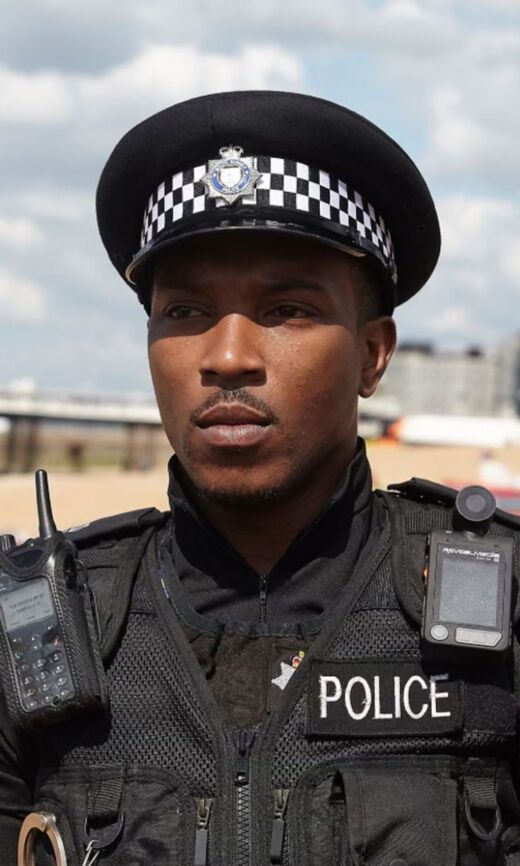
Photo Courtesy of Hello Magazine
Three Black officers. Three regions. Three supervisors. One strikingly identical story. “I’m not asking anyone to lower the bar,” Paul said. “I’m asking why the bar, for me, seemed to move every time I met it.”
If you are Caribbean and you are reading this, you felt that sentence in your chest before you finished it. It is the oldest game in the institution’s playbook, not a wall, but a moving target. Credentialed enough? We will question your communication style. Fluent enough? We will mock your accent. Decade of service behind you? We will find a reason before your probation ends. The cruelty is in its precision: it never says, “You don’t belong here.” It just makes belonging impossible, and it is not happening only inside police stations.


Right now, corporate landlords are filing eviction applications in Black-majority Toronto neighbourhoods at six times the citywide average, a pattern researcher at Toronto Metropolitan University have stopped calling displacement and started calling “racial banishment.” The strategy is deliberate: buy cheap in Black neighbourhoods, evict at scale, rebuild for whiter, wealthier tenants. Little Jamaica, the cultural heartbeat of this city’s Caribbean community, is watching it happen in real time along Eglinton West. At the same time, the Crosstown LRT construction has already gutted Black-owned businesses that were the neighbourhood’s spine.
The federal government’s response to all of it? This week, they announced six million for Canada’s Black Justice Strategy, a ten-year plan. Advocates who have spent careers documenting anti-Black racism in health, housing, policing, and employment said, politely, that it was not enough. That is the official word. Not enough.
So, what do we do with a moving bar, a city that wants to banish us, and a government throwing us table scraps and calling it strategy? We build what they will not.

Photo Courtesy of Mister X
The Little Jamaica Community Land Trust is already fighting for community-owned affordable housing on Eglinton. Tenant unions in York South-Weston have led rent strikes involving 500 tenants. The pardna and the susu (Caribbean mutual aid as old as our grandmothers) are being reimagined as community financing models for Black-led organizations that cannot access traditional capital.
This is the radical act: not waiting for an institution to decide we belong in it. Building the thing ourselves. Owning the land, holding the space, and keeping the culture.
Paul went into policing because he wanted his community to see someone like him in uniform. That impulse (beautiful, brave, and punished) is the same impulse that built every pardna, every community centre, every Caribbean cultural organization this city has ever tried to price out or push through. We do not need their uniform. We need our land