


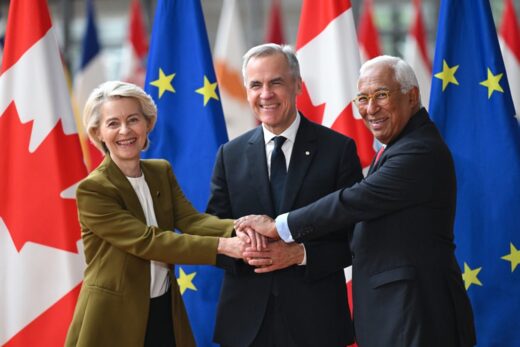

Mark Carney’s outreach to the European Union is a natural extension of Canada’s long-standing historical, social and economic ties with Europe. Those relationships are as concrete as many of the connections Canada once shared with its friends to the south. English and French cultures intermingle with global cultural influences that continue to strengthen Canadian identity.
If America wants our products, buy them. Canada should recognize that the relationship it once had with its southern neighbour has changed, shaped by necessity, political differences and competing economic interests.
So, how will Canada’s relationship with the European Union develop?
First, Canada can strengthen its military and security relationships with NATO allies and European partners. Canada and the EU have already expanded cooperation in defence and security, including through the Canada-EU Security and Defence Partnership. Recent Canadian-EU discussions have also focused on defence-industrial cooperation and economic security.
Second, economic and financial opportunities can continue to expand between Canadian and European partners. The Comprehensive Economic and Trade Agreement (CETA), provisionally applied since 2017, has already reduced many tariffs and trade barriers. In 2025, the EU accounted for 8.6 percent of Canada’s total trade, while bilateral trade increased by 10.9 percent.
Third, deeper trade cooperation can create more opportunities for Canadian businesses. Canada and the EU launched negotiations toward a digital trade agreement in 2026, while both sides continue working to strengthen supply chains, critical-mineral cooperation and economic security. These can affect investment, jobs, exports and the ability of Canadian companies to reach new markets.
Fourth, a stronger European relationship could give Canada greater room to diversify its economic partnerships. For decades, Canada’s economy has been deeply connected to the United States. Building stronger relationships elsewhere does not require abandoning that relationship; it does however give Canada more options and reduce the risks that come with relying too heavily on one market.

Fifth, closer Canada-EU relations could have implications beyond Europe. Canada’s position as a North American country with deep Caribbean connections creates opportunities for trade, investment and cultural exchange. Canada’s Caribbean relationships are important in their own right and should be developed strategically. However, those opportunities should not be confused with EU membership or automatic access to Caribbean markets.
Sixth, Canada can pursue a more confident role on the global stage by strengthening partnerships with countries that share overlapping economic, security and democratic interests. Canada does not need to become someone else’s junior partner to be influential. It can build relationships based on mutual interests and practical cooperation.
Yes, Canada can pursue greater global ambitions through a stronger relationship with Europe, but there is an important distinction between deepening Canada-EU cooperation and becoming a member of the European Union. Canada is not an EU member, and membership would require a far more complicated political and legal process than expanding trade and strategic cooperation. The idea of Canadian EU membership is therefore better understood as a provocative long-term concept than an immediate policy option.
The question is not whether Europe replaces the United States. Canada can build a broader network of relationships that protects its interests and expands its choices.
Canada’s relationship with the United States will remain geographically and economically significant. At the same time, Europe offers another avenue for Canada to strengthen trade, security and international cooperation. In fact, the relationship is already moving in that direction: Canada and the EU are preparing for their next summit in Canada on October 29th–30th, 2026. It is becoming part of a Canadian strategy to diversify markets, deepen alliances and strengthen its position in an uncertain global economy.
The future may not be about choosing one side of the Atlantic over another. It may be about Canada recognizing that it can have meaningful partnerships on both sides, and act with greater independence when its national interests require it.
Stay in the loop with exclusive news, stories, and insights—delivered straight to your inbox. No fluff, just real content that matters. Sign up today!