Feature Spotlight
Caroline Mahfood – Drawing the lines of her own court
“My weakness; I would be on the computer at night working and I regret that. I regret that I would not just shut down.”

We know the public portrait. Caroline Mahfood is the Chief Executive Officer of the GraceKennedy Foundation, managing millions of dollars in international grants and spearheading the high-profile Kingston Harbour Cleanup. She oversees an independent corporate endowment and cheerfully declares to the world that she has “The best job ever.” Look closer at her life’s invisible architecture, and you find a striking contradiction.
She is a fiercely competitive sportswoman who once represented Jamaica in junior tennis, table tennis, and badminton. “I’m highly competitive,” she warns with a warm, delightful laugh. “You don’t want to play cards with me.” Yet, her career’s defining mission has been the absolute opposite of self-interest. Her competitive drive is not aimed at defeating others, but at letting other people win. She channeled that unstoppable energy into corporate service, creating a psychological friction: she protects everyone else’s boundaries with absolute devotion, yet she will admit; she struggled for decades to draw boundaries for herself.
To understand this tension, go back to her beginning. Caroline was born and raised on the University of the West Indies campus, where her father was a professor and doctor, and her mother worked in administration. It was an academic, class-free playground. “It actually was an incredible childhood,” she recalls of when children of all walks roamed free. “We were never in our homes. All of us from all walks of life were on the road doing stuff, playing sports, swimming, tennis.”


Photo Courtesy of GraceKennedy
It was a world free of prejudice and classism, where she sat at the kitchen tables of famous economists without ever connecting the dots of their social standing. Growing up with three older brothers forced her to grow tough. “You have to always try to keep up with them, and if you cannot, then you cannot play,” she explains.
She excelled at sports, which became her passport to respect, but she did not take high school seriously. The real shift came in nineteen eighty-seven, when she became a committed Christian. “I did not grow up religious at all,” she notes, but she was blown away by the Bible. That spiritual awakening grounded her competitive fire, leading her into several years of full-time ministry. It was a season that permanently reshaped her relationship with power, proving that value has nothing to do with social status.
Taking over the GraceKennedy Foundation in 2008, her leadership was marked by this same radical egalitarianism. She aligned corporate philanthropy with national development, doing so with an empathy that bypassed corporate coldness. Realizing scholarship recipients faced hunger despite tuition support, she launched a campus food bank. She coordinated cleanup projects and brought diaspora youth back through the Birthright Programme. For Caroline, helping others was a calling. “I know there is more to people than where they come from,” she says softly. “There’s potential in everybody to be great.” This relentless devotion to service came at a silent, heavy cost. Her greatest weakness, she confesses, was creating boundaries. While she established a legendary rule to protect her staff, “My staff, they are not missing a sports day. If there is anything to do with their kids, they are going to that,” she granted herself no such grace. She became a sanctuary for others, but she left no room for her own sanctuary.


The crisis of this self-neglect unfolded in the quiet hours of her home. “On the other side, where I regret is with my husband,” Caroline says, her voice dropping into a rare, vulnerable stillness. “You make the time for the kids to do what you need to do, but then I would be on the computer at night working long hours and I regret that. I regret that I would not just shut down and have firmer boundaries.”
For twenty-nine years, her husband was her anchor, fighting his own courageous battles. It is the classic paradox of the professional woman: she felt she had to be everything to everyone. She could negotiate million-dollar climate grants and manage complex multi-partner environmental coalitions, yet she had a hard time pressing the power button on her own laptop to sit in silence.
Then came the ultimate shattering. In November 2024, her husband passed away after a long struggle with cancer. The loss was a profound reorganization of her psychological universe. “Life is really short,” Caroline says, the realization sharp and unvarnished. “I have decided to do the things that you are always saving the money for in the future.”

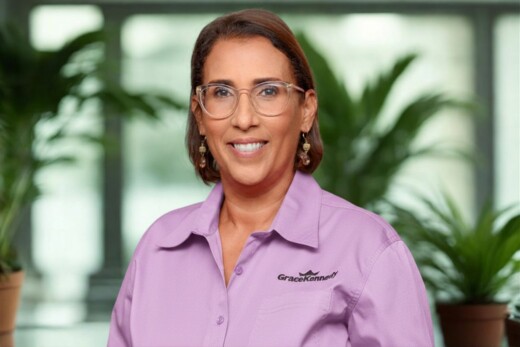
Photo Courtesy of GraceKennedy
For a woman who spent decades putting everyone else’s mask on first, she had to learn the hardest lesson of her life: self-care is not a compromise of service. Self-care has to come at the foundation of everything you do. She returned to the tennis court, went back to the gym, and began traveling. She even sought the help of a psychologist. “You have got to take care of yourself,” she admits, acknowledging a truth that many Caribbean women, bound by cultural expectations of strength, rarely voice.
Her legacy is no longer defined by the corporate ladder, but by the quiet wisdom she offers to the next generation of young women. “Don’t compromise on your integrity,” she advises. “Protect your staff. Don’t use people as steppingstones. Pull them ahead.”
Today, she still finds joy in competition, occasionally traveling to England just to watch her favorite Formula One driver, Lewis Hamilton, race. At her core, Caroline Mahfood remains a competitor, but she has finally learned to draw the lines of her own court, recognizing that the most important victory is the one you win for your own peace.