


on
BY SIMONE J. SMITH
“What good is the land if we don’t have our children.”
I had the opportunity to attend the 2022 Indigenous Leadership & Business Congress, and although my attendance had me facing some tough truths about Canada, and the Canadian government, it allowed me to really delve into just how drastically the Canadian government has failed the indigenous community, and how similar the plight of the indigenous community and the African-Caribbean community is.
As many of us know, Canada has a harrowing past when it comes to its indigenous peoples and especially their children. Many of us are familiar with residential schools, which operated between 1831 and 1996, in which children were taken from their families to assimilate them.
Then there was the ‘Sixties Scoop,’ where the government rounded up thousands of Indigenous people for adoption by White Canadian families. Some children were even sold abroad. Despite attempts at reconciliation, these communities are still not treated equally and the youngest are extremely affected.
Indigenous communities are found throughout Canada, and include the: Inuit, First Nations and Métis (of mixed origin). Within these designations there are more than 630 different nations, communities and communities within a nation. The diversity of Canada’s Indigenous peoples is what makes the country so culturally rich, but an issue common to all its communities is that children’s rights are not respected and young people find it hard to assert their rights. With that is the: social, economic and quality of life that continues to be disregarded by our government, even though they continue to make promises to give back to the people that so much has been taken from.
There is so much that needs to be taken into consideration; infant mortality among Aboriginal children is three times the rate of non-Aboriginal kids. The suicide rate for Aboriginal people is six times higher than for others. On average, life expectancy for Aboriginal people is a decade less than for non-Aboriginal people.
With that as context, we have to ask ourselves: what has been, and continues to be, the biggest public policy failure in Canada? In all measures the answer has to be Indigenous and Aboriginal policy. In terms of social, economic and quality of life outcomes, nothing comes close to the failure of generation upon generation of government policy relating to Indigenous people.
This unfortunate trend has now placed the world on a trajectory of ineffective leadership in the corridors of power in many nations, with wars raging and rising cases of discrimination, racism and injustices against Indigenous peoples, and people of African descent.
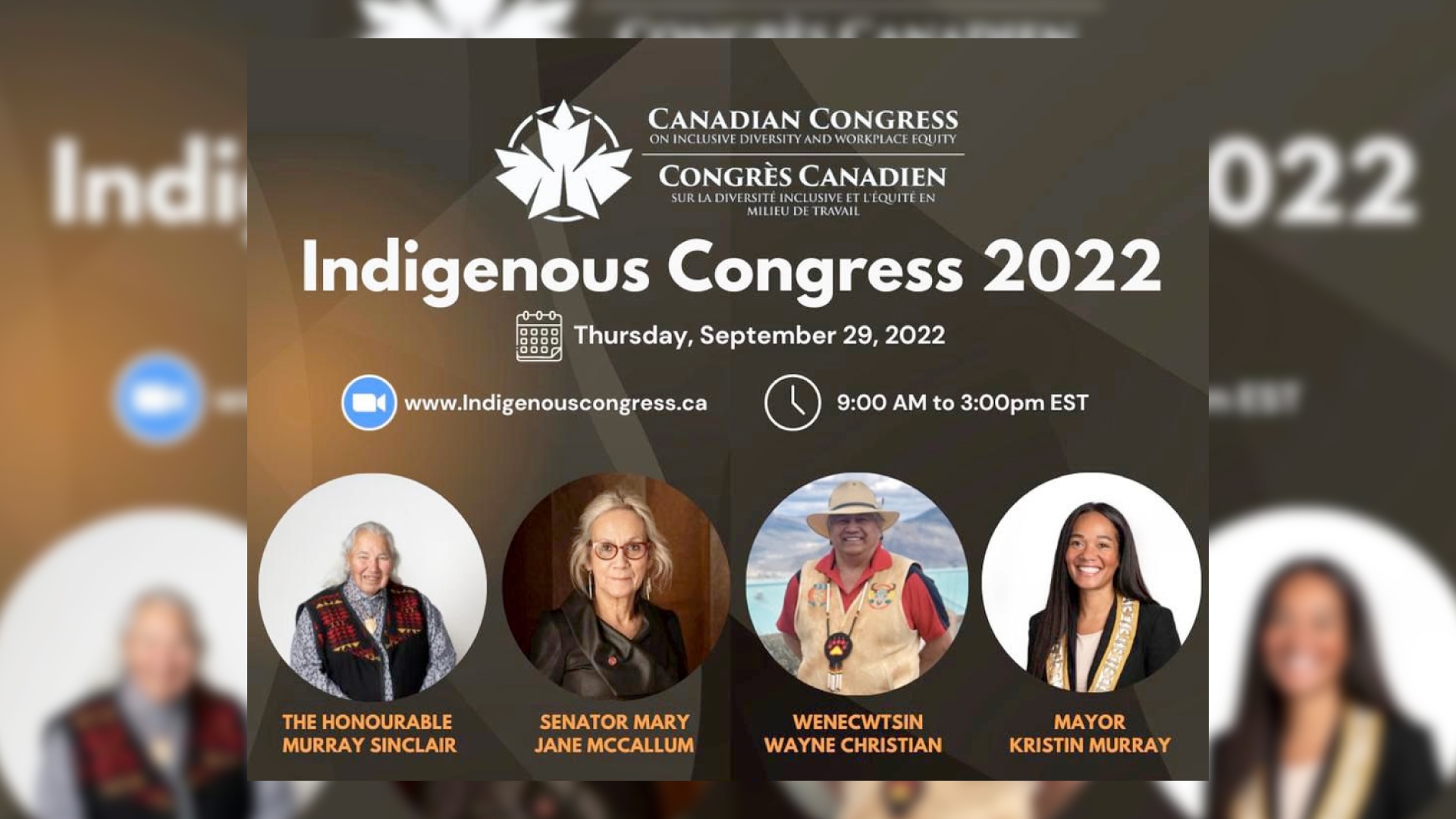
On September 29th, 2022, in honour of the National Truth and Reconciliation Day in Canada, the Canadian Congress invited thousands of people all over the world to be part of the Second Annual Indigenous Congress, 2022.
With a focus on developing leadership capabilities of thousands of delegates, and sharing sacred ways of empowering oneself and each other through whatever challenges you may be faced with, this virtual gathering provided perspective about the Indigenous ways of coexisting as one, and highlighted just how abhorrent the treatment of Indigenous people in Canada actually is. The Congress focused on:
- Generational Healing
- Equitable Justice and Governance
- Generational Wealth
And explored topics surrounding:
- The Role of Government in Indigenous Wealth Creation
- Indigenous Principles for Economic Empowerment
- Redefining Generational Wealth – Indigenous Perspectives
I learned that in general, the employment rate for Indigenous people is lower than for the general population of Canada. According to the 2016 (Canadian Encyclopedia) census, the employment rate for non-Indigenous people aged 25 to 64 was 76%. Their Indigenous counterparts had lower rates. First Nations people on reserves had an employment rate of 46.9%; the rate off reserves was 60.2%.
In terms of income, Indigenous workers made less on average than the general population, although the amount varied. According to 2016 (Canadian Encyclopedia) census data, the median income of Indigenous people living on reserve ($20,357) was considerably less than that of non-Indigenous people ($42,930). Métis had the highest median income among Indigenous people with $40,814, followed by Non-Status people ($34,458), Status people living off reserve ($32,553), and Inuit ($33,135).
The hard part is what to do about it? How do we bring equilibrium to an unbalanced situation? The issues that Indigenous communities face are so interwoven in the history of colonialism, so deeply rooted in attitudes, patterns of racial discrimination, biases and cultural conflict. Despite considering itself as the upholders of rights of Aboriginals, this perception is far from reality. Canada has failed its Aboriginal peoples, leaving both sides ensnared in a broken relationship.
Stay in the loop with exclusive news, stories, and insights—delivered straight to your inbox. No fluff, just real content that matters. Sign up today!

We, as humans are guaranteed certain things in life: stressors, taxes, bills and death are the first thoughts that pop to mind. It is not uncommon that many people find a hard time dealing with these daily life stressors, and at times will find themselves losing control over their lives. Simone Jennifer Smith’s great passion is using the gifts that have been given to her, to help educate her clients on how to live meaningful lives. The Hear to Help Team consists of powerfully motivated individuals, who like Simone, see that there is a need in this world; a need for real connection. As the founder and Director of Hear 2 Help, Simone leads a team that goes out into the community day to day, servicing families with their educational, legal and mental health needs.Her dedication shows in her Toronto Caribbean newspaper articles, and in her role as a host on the TCN TV Network.