Likes & Shares
Building Working Power
“It was heartbreaking… Everyone wanted to help.” — Kerryann, housekeeper, Marriott City Centre

Kerryann carried a suitcase to Canada in 2013 as well as her family’s future on her back. For more than a decade, every paycheque from her hotel job in Toronto became a lifeline to Jamaica: food, school fees, medicine, roof repairs. When Hurricane Melissa tore through her mother’s community in October 2025, that lifeline turned into a rescue rope. Within days, she wired money home. Her coworkers collected donations. Her union-backed job gave her the stability to act when disaster struck.
A union built by immigrants, women, and the Caribbean
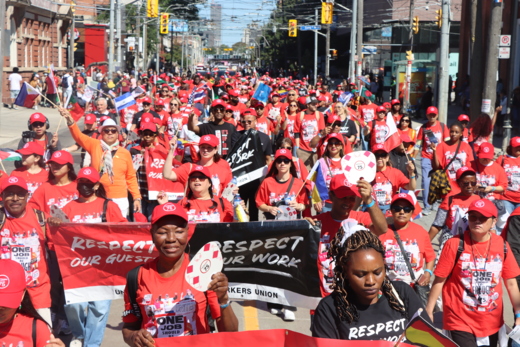
https://www.uniteherelocal75.org/about-local-75/Local 75’s roots in Toronto run deep; back to the 1890s, when hotel and restaurant workers first organized in this city. The 2004 merger of UNITE and HERE created UNITE HERE International, the strongest hospitality union in North America by membership and contract standards. Today, Local 75 represents nearly 8,000 workers across the GTA: housekeepers, cooks, servers, banquet staff, front-desk agents, laundry workers, casino employees, and maintenance teams. Most are immigrants, women, and people of colour. Many are Caribbean.


Photos Courtesy of HTAC 75
They work in hotels, restaurants, casinos, racetracks, airport concessions, and food-service employers from Rexdale to Scarborough, Brampton to Mississauga, North York to downtown. Their leadership (elected by members) reflects that diversity.
Unionization here is not abstract. It’s wage floors above minimum wage, health and dental benefits, pension contributions, paid sick days, scheduling protections, severance, recall rights, and job-security clauses. Collective agreements include language on harassment, discrimination, workload, and safety. Workers have been promoted and trained through union programs. During the pandemic, the union fought for rehiring, recall rights, and protections against permanent layoffs.
Major campaigns include the Fairmont Royal York fight; workers publicly argued in November 2024 they had not received a wage increase since 2021. The Rexdale Rising campaign secured Canada’s first Community Benefits Agreement tied to the Woodbine Casino development. The union has also been involved in hotel redevelopment debates, including the Chelsea Hotel case.
HTA 75: Training as survival, not just skills
HTA 75 was born in 2020, when the pandemic wiped out thousands of hospitality jobs overnight. What started as a virtual rapid-response centre evolved into hybrid, then primarily in-person programming. Since 2020, HTA 75 has trained over 2,300 Local 75 and Local 261 members and delivered more than 80 programs. Programs include culinary training (cook, assistant cook, chef, baker), housekeeping, front-of-house, digital skills, certifications (Smart Serve, food handling, first aid), career services (resumes, interviews, job matching, coaching), and wellness support (mental-health groups, financial seminars).


HTA 75 is funded by the Government of Canada and Ontario’s Ministry of Labour, Immigration, Training and Skills Development, with a federal announcement identifying $3.4 million over three years for a program involving HTA 75, Local 75, and Local 261. It is operated by Local 75, with governance and accountability tied to the union.
. Programs blend classroom learning with hands-on practice, paid placements, resume and interview prep, job matching, and career coaching. Wellness support includes mental-health groups, peer support, and financial-management seminars. Services are delivered online, in-person, and in hybrid formats, with accessibility for newcomers, people with disabilities, and workers with limited English.
The community benefit is direct: workers gain skills that meet employer demand, secure better wages, and access promotion pathways that reduce turnover and precarity. HTA 75’s partnerships with unions, employers, governments, and community organizations align training with real job openings, helping graduates move into unionized roles with benefits, pension contributions, and job-security clauses. For immigrant and Caribbean workers (who often face credential barriers and discrimination) this pipeline is economic mobility and transnational stability for families sending remittances home.
Photos Courtesy of HTAC 75
The Caribbean dimension
Caribbean workers are the backbone. Jamaican, Trinidadian, Guyanese, Grenadian, Haitian, and other Caribbean communities are represented among members. Many send remittances home, making wage levels and job security matters of transnational survival. Caribbean workers hold steward roles and elected positions. Immigration status, racial discrimination, accent bias, and credential barriers still shape their experiences. Churches, cultural associations, immigrant-service organizations, and community media are part of the ecosystem.
Can a union and its training centre rebuild Toronto’s hospitality workforce while also changing the low-wage, precarious conditions that have long defined the industry?
Kerryann’s story says yes, but only if we keep the pressure on.