

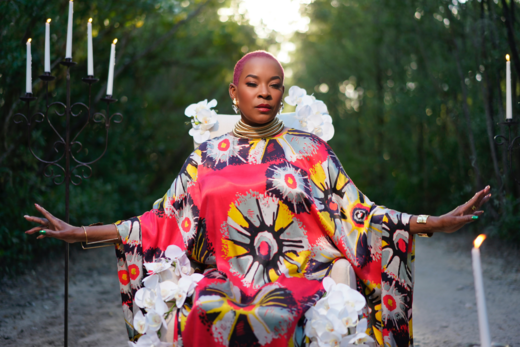

We know the name.
For nearly half a century, the public has consumed the Marley surname as a globally standardized brand of peace. We think we know the people behind it: the icons, the harmony singers, the siblings who conquered stages, but for Sharon Althea Marley, the public mythology has stood as a glittering cage that simultaneously elevated and obscured her. The world remembers her as a central pillar of the Melody Makers, a three-time Grammy winner standing adjacent to her siblings.
What has not been understood is the silent, complex choreography of her independence. To understand Sharon Marley, one must look at the quiet years of her long, patient pause. It is a striking contradiction: a woman raised inside the most hyper-visible musical dynasty on Earth, who spent twenty years completely silent as a singer. To see her only as a supporting branch is to miss her entirely. The real story is about her fire.
Sharon is currently visiting Toronto, and will be here for another week, preparing for an intimate performance and in-conversation Q&A at the Ode Hotel on Dundas Street West this Thursday, August 27th, 2026. It is a rare, vulnerable moment. For a woman who spent her life protecting and curating her family’s massive archives and museums, she is finally standing before the world as her own protagonist. Her debut solo album, Firebird, is a spiritual resurrection recorded in the love frequency of 432 hertz.
“Firebird is about rising above life’s challenges with grace and resilience,” Sharon says softly, her speaking voice carrying a raspy, warm weight. “A reminder that we can rise from the ashes, no matter how many times we’ve been burned.”
To trace that ash is to go back to Trench Town, Kingston before the stadium tours. Long before she realized her family was famous, Sharon lived in a community under the iron hand of her grand-aunt, who ruled with structural discipline.
“A scent of Trench Town would be stew peas cooking on Thursdays,” Sharon smiles, remembering the sensory details of her early childhood. “I remember coming home from school one Thursday evening and there were no stew peas. Auntie said, ‘We only have cabbage.’ She cooked the cabbage with potato. I was very upset, but at the same time, we still had something to eat while many went without anything.”
Even then, her grand-aunt enforced an almost militaristic pride. “I remember very clearly how important cleanliness was to us,” Sharon recalls. “Being neat; like my uniform was ironed with starch so it was stiff, and all the pleats were in place. We were clean and always tidy. I grew up neat and well put together.”
That structured peace was shattered on a December night in 1976, when Sharon was just twelve years old. Gunmen entered the Marley home, shooting her parents, Bob and Rita. The trauma of that night became the dividing line in her life.
“All I remember is the police siren at the gate and auntie came and woke us up and said, ‘Come, come, we have to go,'” Sharon says, the memory still fresh. “We went in the car straight away, the police car in our nightgown. While we were in the car, I remember hearing the communication on the police radio, and we were just excited, being in the police car. It felt like we were in a movie until we saw our parents. Bob had on the bloody bandage, and mom had on the thing around her head. That is when we realized our family is different.”

They were forced to leave Jamaica, isolated from the world by bodyguards. “Bob said, ‘Look, you guys have enough friends, and you do not need any more friends. You have enough brothers and sisters,'” Sharon reflects. From that isolation, a psychological armor was born. “We developed that permanent screw that Stephen sings about in rebel in disguise. We inherited the permanent screw because from that we realized that people are really trying to harm our parents.”
This permanent screw protected her, but it also locked her voice away. For 20 years after the Melody Makers disbanded, Sharon stepped off the stage. She raised children, ran the Bob Marley Museum as a curator, and worked as a Montessori educator, finding purpose in the quiet, tactile world of service.
“My acupuncturist explained that the neck is connected to the throat, and the throat is used for speaking,” Sharon reveals. “So, if you have a problem with the neck, it’s because you have some fear with that. Twenty years I went without singing.”
The breakthrough came from an irresistible spiritual awakening. “My voice started to come through. It was an inner yearning. An awakening is what it was.”
She recorded Firebird, collaborating with her children, Ingemar and Donisha Prendergast, and local artists like Komi Olaf, whose Toronto-painted album cover depicts her adorned with butterflies and flowers, vivid symbols of rebirth. She chose to record in four hundred and thirty-two hertz, a frequency designed to feed the spirit.
“A lot of people don’t understand frequency because we are so used to the physical,” Sharon muses. “I did not want to just do music for the sake of doing music. I want my music to do something for people.”
Ultimately, Sharon Marley’s journey is a familiar human struggle to find one’s footing in a noisy world. When her young grandson suddenly wanders into her room mid-interview, interrupting her with a child’s natural urgency, she instantly melts from a cultural icon into a warm, present grandmother, instructing him gently to say “Excuse me” before she pulls him close. It is in these unvarnished, everyday spaces, far from the glare of international stadium lights, that Sharon’s true power resides.
She is a woman who, despite inheriting a permanent screw of self-protection and carrying decades of silent, physical blockages in her throat, finally chose to sit still, tap her chest to quiet her anxiety, and listen to her own spirit. In doing so, she reminds us that no matter how long we have stayed silent, or how intimidating the shadows of our past may be, we are all capable of rising from our own ashes, reclaiming our own frequencies, and beginning our finest chapters exactly when we are ready.
At the Ode Hotel, Sharon will perform her new work alongside classics like “No Woman, No Cry.” For Sharon, this is a continuation of her father’s voice as a learning tool. She is no longer hiding behind a collective surname.
“I have no playbook of where I want to be,” Sharon smiles. “Wherever I am led, that is where I am going to be.”
Stay in the loop with exclusive news, stories, and insights—delivered straight to your inbox. No fluff, just real content that matters. Sign up today!