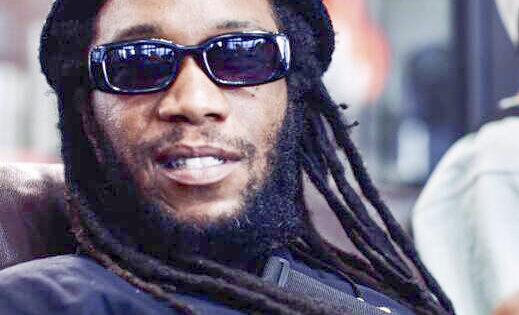

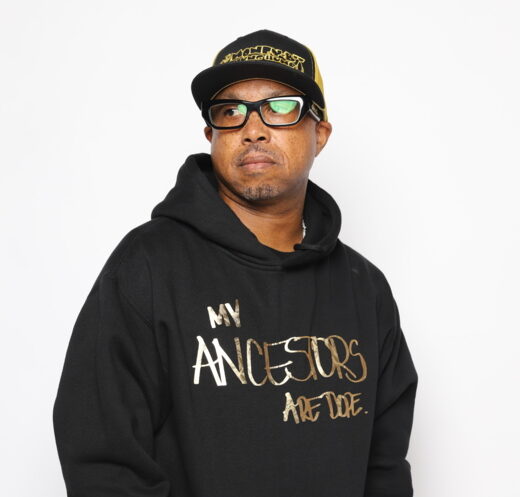

What has already been said about the man known to the world as Money B? He is the man who stood adjacent to the giant prosthetic nose of Humpty Hump, delivering pristine, rapid-fire verses on multi-platinum records that soundtracked the carefree excess of the early 1990s.
To look at Money B (aka, Ronald Brooks) and see only a party-loving celebrity is to completely miss the emotional truth of his existence. The deep contradiction at the center of his life is that one of hip-hop’s most notoriously theatrical party-starters is, in reality, a deeply quiet, self-contained survivor who values community far more than the spotlight. He is a man who saw his comrades consumed by the predatory machinery of the music industry and the street, yet managed to preserve his dignity, his sanity, and his history.
Photographer: Tyrone Richardson
To understand Money B, you have to peel back the layers of the Oakland community that raised him and separate the human being from the corporate product…
Long before he was riding in a drop-top convertible Mustang with dual exhaust down Telegraph Avenue, Brooks was a child of the revolution. Born in September 1969 at the height of the Black Power movement to parents Bobby McCall and Sandra Brooks, he was wartime born. “I’m a Panther Cub, wartime born, 1969,” Brooks says, grounding his identity in political warfare. “Revolutionaries raised me, a period in our history when racial tensions were incredibly high and equal opportunity was a foreign concept. The Party provided us kids with a place of peace. To live, to learn, to thrive. An oasis in a desert.”
His childhood was not characterized by the chaotic neglect that mainstream media often projected onto African American inner-city families; instead, it was structured by the radical, collective care of the Oakland Community School (OCS). At OCS, under director Ericka Huggins, he received a top-tier education. He ate three family-style meals a day, participated in spelling bees that felt like March Madness, and attended writing workshops led by James Baldwin and Maya Angelou. Rosa Parks visited, and the children put on a special performance of “The Bus” skit.

“We were not treated like little kids,” he remembers. “Instead, we were groomed to be our own functioning community… OCS had prepared me for exactly that.” When he graduated from the sixth grade in 1981, Huey P. Newton himself stood on the stage to hand him his diploma. It was an education designed to teach him how to think, not what to think; a critical shield that would later protect him from the toxic illusions of celebrity.
When OCS closed its doors, Money B was thrust into the stark reality of the 1980s public school system, where he quickly realized the world outside his revolutionary oasis was hostile. Standing at Berkeley High as a small, skinny teenager who looked years younger than his actual age, he became an immediate target for neighborhood bullies. “When I was sixteen, I probably looked eleven,” Brooks says. ” Berkeley High definitely had one punk-bully… One day I got so tired of not being heard, I went home and recorded a rap about the dude.”
That home recording was the pivot. The visual artist and breakdancer known as the Egyptian Kid was replaced by Money B, a name given to him by his cousin Greg that became his permanent skin, but as he honed his mic skills, the crack epidemic slammed into Oakland like chemical warfare.
Money B eventually dabbled in slinging to survive, surviving near-misses and police raids by mere minutes. “Opportunity to become a variety of statistics was just outside my door every day,” he notes, acknowledging the structural trap set for marginalized African American youth to feed California’s for-profit prison system, but his focus remained on the music.
Digital Underground was born through tactical negotiation. When Shock G and Chopmaster J sought DJ Fuze for their new project, Fuze refused to join without Money B. While Shock G’s theatrical characters like Humpty Hump took the center stage, Money B was content to be the reliable, laid-back anchor of the collective. He did not need the superficial validation of the front spot because he understood that the group was bigger than any individual.
This ego-free posture allowed him to play a pivotal, big-brother role to the group’s most explosive young member: Tupac Shakur. Because of their shared Black Panther lineage and his notoriously easygoing nature, the two were paired as roommates on tour. Money B became Shakur’s anchor in the real world, connecting him with the streets while trying to steer his volatile genius away from self-destruction.
“I spent a lot of time saying things like: ‘Don’t do that.’, ‘Don’t say that.’, ‘That’s not a good idea.'” Brooks reminisces. He watched as Pac manifested his own tragic destiny through his lyrics. “Pac had track after track where he’d be talking about his own demise… I remember telling him a number of times along the way that he ought to be careful or he was going to bring that shit on himself for real.”
In 1999, he suffered the most devastating loss of his life: his three-month-old daughter, Taylor, passed away in her sleep from SIDS. The grief was overwhelming, temporarily shutting down his creative drive. Yet, his wife Tonia’s boldness to try again led to the birth of their son, Tariq, allowing him to fully embrace the quiet, intentional fatherhood he missed with his first son, Maurice, during his years on the road.
In the years that followed, he faced a nightmarish civil judgment of thirty-four million dollars for an incident he had absolutely nothing to do with, decimating his finances for years. He survived the sudden, painful passing of his closest brother, DJ Fuze’s partner, Shock G. He watched his cousin James lose his life to the streets after a system of systematic disenfranchisement swallowed him whole.
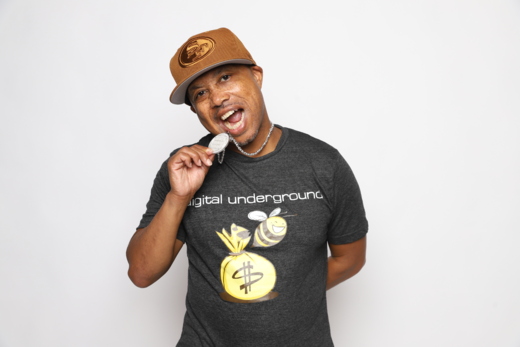
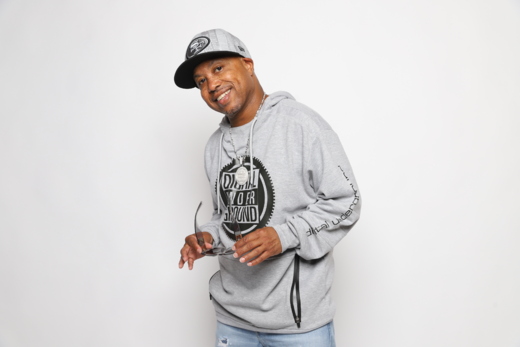
Photographer: Tyrone Richardson
Yet, he is not bitter. Today, he stays young by remaining a glutton for knowledge, learning financial literacy, and running his product line, Underground Extracts. He actively manages fresh Oakland talent like Lil Mikey T.N.C. and tours the country with Young Hump (the son of legendary bassist Stanley Clarke), keeping the funk-filled, inclusive legacy of Digital Underground alive for a new generation.
For anyone who wants to understand the true history of hip-hop, Ronald Brooks’s autobiography, “A D.U. Party Don’t Stop: The Money B Story” (co-authored with Chad Coenson), is mandatory reading. It is not a standard, sanitized celebrity memoir. It serves as a textbook on how an African American man raised by revolutionaries navigated the predatory traps of the street, the corporate music industry, and the devastating grief of personal loss, emerging on the other side with his soul fully intact.
For inquiries regarding book and film intellectual property rights, contact Tracy Lamourie, Founder, Managing Director, and Senior Publicist at LAMOURIE MEDIA
Stay in the loop with exclusive news, stories, and insights—delivered straight to your inbox. No fluff, just real content that matters. Sign up today!