

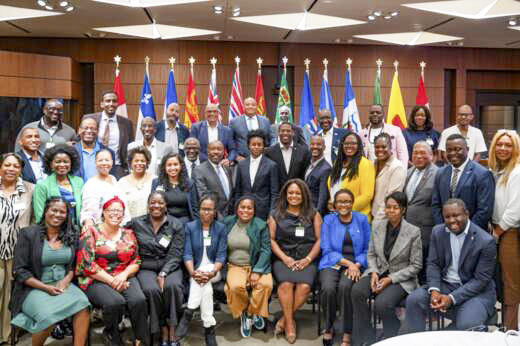

The incorporation of the Canadian Congress of Black Politicians (CCBP) in early August marks an important development in Canada’s political landscape. The organization, formally announced as a national body this month, is intended to support Black elected officials across Canada as they navigate challenges involving representation and discrimination.
The launch was reported by Catherine Morrison of The Canadian Press, with coverage appearing in several Canadian media outlets. The significance of the CCBP is not simply that another political organization has been created. Its stated purpose is to build a national network where Black politicians from different levels of government and political parties can collaborate, mentor one another and advocate for stronger representation.
Michael Coteau, Liberal MP for Scarborough, helped assemble the organization about a decade ago. Speaking at a press conference in Ottawa, he described the organization’s growth as refreshing and explained its broader purpose, “This organization was established to build a network across the country so Black politicians from all levels of government and from all political stripes could come together.”
That non-partisan approach is central to the organization’s significance. Stephen Wright, a former Peterborough city councillor who attended the launch, reflected on the journey in an August 9th Facebook post. He wrote that what began ten years ago with a small group of Black elected officials in Nova Scotia questioning why they were working in isolation has grown into a permanent institution spanning federal, provincial, municipal and school-board politics. “Institutions outlive the people who build them,” Wright wrote. “That’s the point.”
The need for such an institution is underscored by Canada’s changing political representation. According to the Canadian Parliamentary Review, the 2025 federal election produced a record 62 visible minority MPs, up from 53 in 2021. Their share of the House of Commons increased from 15.7% to 18.1%. While those figures represent progress, the same analysis notes that visible minority representation remains below their share of Canada’s population.

For Black politicians specifically, representation is only part of the story. A 2025 study by Carleton University and Operation Black Vote Canada found that most Black Canadians surveyed reported experiencing discrimination from members of the public, other politicians, legislative and municipal staff, and the media while running for or serving in public office. Lack of financial resources and shortages of volunteers were also identified as key barriers.
The report found that most Black candidates run at the local level rather than provincially or federally. Yet increased numbers do not automatically produce inclusion. Colleen James, chair of the CCBP and a councillor in the Waterloo region, emphasized the distinction. “Oftentimes we may be the only Black individual around the table.” She also described the experience of being underestimated, “Sometimes people don’t even think that you are the elected official.”
These experiences point to an issue deeper than numbers. Representation can place someone at the table; inclusion determines whether they are recognized, supported and able to participate fully once they arrive.
James also highlighted the isolation that can accompany political leadership and the importance of having a support system. That may ultimately be one of the CCBP’s most consequential roles: ensuring that Black Canadians considering public office know they are not entering political life alone.
The incorporation of the CCBP therefore represents more than an organizational milestone. It is an attempt to build infrastructure around political participation, one that can connect elected officials across party lines, create mentorship, and help future candidates navigate barriers that have too often been faced individually.
There is reason for optimism, but the real measure of success will not be the organization’s launch. It will be whether the CCBP can help turn increased representation into meaningful inclusion, sustained participation and a stronger pipeline of Black political leadership across Canada. The challenge now is ensuring this national network becomes a lasting source of institutional strength, not simply a symbol of progress announced at launch.
Stay in the loop with exclusive news, stories, and insights—delivered straight to your inbox. No fluff, just real content that matters. Sign up today!