

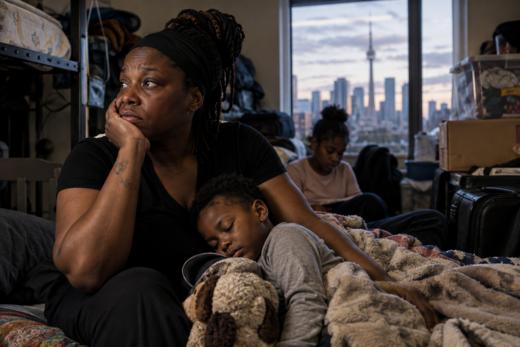

Our community rarely tells this story aloud. It happens behind closed doors; in living rooms too crowded with cousins and strangers who became kin out of necessity. It happens in the parking lots of shelters where Black women sit in their cars, unable to bring themselves to walk through the door. It happens in the voicemail’s landlords leave unreturned after hearing an accent and deciding, before the conversation even began, that the answer was no.
The housing crisis in Canada is not colour-blind, and in the Toronto Caribbean community, we are bearing a weight that the headlines rarely name.
Black Canadians are significantly more likely to experience housing insecurity than their White counterparts: more likely to live in overcrowded conditions, to spend more than fifty percent of their income on rent, and to face discriminatory barriers in the rental market. Black women, especially single mothers and women navigating disability or mental health challenges, are among the most vulnerable. Yet, in the public conversation about the housing crisis (in the op-eds, the policy papers, the government task forces) our faces are rarely the ones used to illustrate the problem.
This is not an accident. It is the predictable outcome of systems that were never designed with us in mind.

For Caribbean families in the GTA, the barriers compound in ways that rarely get spoken about. Many of our parents and grandparents came to this country with nothing and built something through discipline, sacrifice, and the refusal to complain. That resilience is real. It is also one of the reasons we so rarely ask for help until the crisis is already upon us. Cultural silence about financial struggle, fear of judgment from within our own community, distrust of the systems that are supposed to help us; these are not character flaws. They are the inherited responses of people who learned, generation after generation, that asking for too much could cost you everything.
So, we double up. We couch-surf. We pay rent we cannot afford because the alternative: the shelter, the hotline, the application, feels like admitting defeat in front of people we do not want to disappoint. We do not show up in the statistics because we have become experts at staying just barely invisible.
The cost of that invisibility is not neutral. It shows up in our mental health, in our children’s school performance, in the chronic stress that lives in the body and does not leave. It shows up in the stories we tell each other in whispers that should be told to city councillors, to housing ministers, to anyone with the power to change what keeps happening to us.
The housing crisis in the Caribbean diaspora is a systemic one, built by discriminatory rental practices, underfunded social housing, racialized income gaps, and a social safety net that treats poverty as a personal failure rather than a policy outcome.
It will not be solved by working harder. We will solve it by demanding better.
We deserve housing. We deserve it because it is a human right. Full stop.
The first step is saying so aloud, together, in every room that will have us, and some rooms that would rather we did not come.
That begins here.
Stay in the loop with exclusive news, stories, and insights—delivered straight to your inbox. No fluff, just real content that matters. Sign up today!