Business
Confidence Is not competence: who gets paid?
“A woman who says ‘I’m not sure’ may be the only one telling the truth.”

She uses AI at night, after the shift ends. She drafts a résumé, tightens a funding email, translates a school letter, and plans a church fundraiser. By day, she works in administration, health care support, retail, education, or her own small business. Nobody has trained her, told her what is allowed. So, she wonders, “Will this make me look lazy? Dishonest? Replaceable?”
That is a rational response to a workplace that hands some people tools, mentors, and permission, while asking others to figure it out alone.
The gap is not ability.

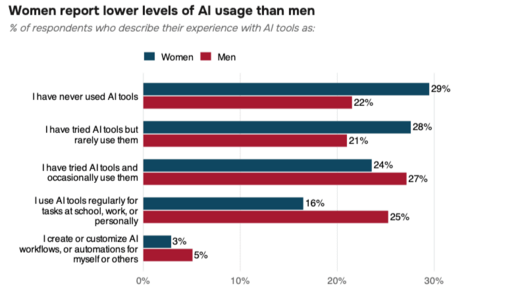
Harvard Study
Harvard’s Shorenstein Center report, Are Women Being Left Out of AI?, found that 64 percent of employed women reported no workplace AI training, compared with 49 percent of men. Women also reported less mentorship and encouragement.
The report also found men named in AI headlines 14.6 times as often as women, and cited as experts 4.3 times as often, even after removing executives, founders, officials, and investors. In other words, the public conversation about AI is not only unequal in access. Unfortunately, it is unequal in authority.
One detail should stop us cold. In the study’s fake executive test, 53 percent of men said they recognized invented AI figures, compared with 40 percent of women. That does not prove men know less. It suggests that certainty is often mistaken for expertise.


Photo Courtesy of She Creative Branding Studio | WordPress
We need to say this plainly: confidence is not competence. A man who says “I know how to use AI” may simply be more comfortable performing knowledge. A woman who says “I’m not sure” may be practicing the caution that good judgment requires.
This is not only an American story. Statistics Canada found that women and men each reported 22 percent overall generative-AI use at work. Once occupation, industry, education, and other factors were considered, women were still less likely to use it.
Toronto Metropolitan University’s research makes the local pattern harder to ignore. Nearly half of women (48.2 percent) reported no workplace AI training, compared with 40.1 percent of men. Among African Caribbean women, 37.0 percent reported no training, compared with 26.3 percent of African Caribbean men. African Caribbean women also reported lower familiarity with workplace AI programs than African Caribbean men: 74.2 percent versus 81.0 percent.


So, the divide is racialized, occupational, and institutional. Think of a Caribbean-Canadian woman in Scarborough working in a clinic, a school office, a call centre, a retail chain, or a family business. She may already be using AI quietly: to write, organize, translate, schedule, or solve problems. She is rarely invited into the meeting where AI policy is decided. She is not named the “AI expert.” She is not paid for the fluency she already has.
Women in the Shorenstein study reported more worry, anxiety, and fear about AI; men reported more curiosity and excitement. The easy story says women are hesitant. The honest story asks: hesitant about what?hesitant about what?
AI is arriving faster than training, workplace rules, privacy protections, and accountability. Concern can be intelligence. It can be the instinct to ask: Who owns my data? Will this tool judge my accent, my name, my neighbourhood? Will it replace the work I do, or make my work invisible? These are the questions of people whose labour has often been undervalued long before a chatbot entered the room.


Photo Courtesy of IDonCarlos85 (Pinerest)
We do not need another panel where men explain AI to women. We need community fluency.
- Employers should fund practical AI training during paid work hours; not after shifts, not as unpaid “upskilling.”
- Unions, colleges, settlement agencies, churches, and community organizations should offer AI literacy designed for shift workers, caregivers, newcomers, and women balancing multiple jobs.
- Mentorship circles should pair African and Caribbean women with practitioners who understand both the technology and the workplace realities.
- Newsrooms, conferences, and funders should stop treating “AI expert” as a default male title. Source African women. Quote Caribbean women. Pay them for their expertise.
- Women can start small: learn one tool, document one task it improves, and name the skill out loud.
Reflect before you move.
- Where have I already used AI without calling it AI?
- What training, permission, or mentorship have I been denied?
- Whose confidence gets rewarded in my workplace, and whose caution gets punished?
- Who in my community needs to be in the room when AI decisions are made?
- What is one AI skill I will learn, teach, or demand access to this month?
AI will shape work whether we are ready or not. The question is whether Toronto will finally train, trust, quote, and pay the women who have been adapting all along.