


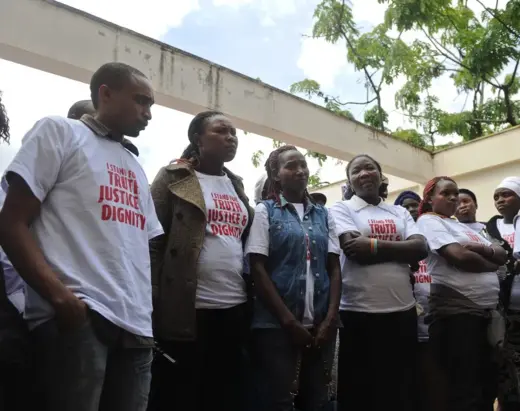

In a case that could redefine the Kenyan government’s constitutional duty to protect survivors of sexual violence committed by both private individuals and state security officers, the country’s Supreme Court is being asked to finally hear voices that have gone unanswered for nearly two decades.
These are the cries of survivors who say justice has been delayed for far too long.
Between 2007 and 2008, eight Kenyans reported experiencing election-related sexual violence during one of the darkest periods in the country’s history. Their case reached the High Court in Nairobi, which delivered its judgment in 2020.
While the ruling acknowledged serious failures by the state, it left four of the eight survivors without compensation because their attackers were private individuals rather than state actors. During the post-election unrest, those four survivors were unable to report the assaults to police due to widespread violence and insecurity.
In 2025, Kenya’s Court of Appeal upheld that distinction despite finding that the state had failed in its constitutional and human rights obligations to prevent, investigate, and prosecute election-related sexual violence.
Now, nearly 20 years later, the survivors are asking the Supreme Court to correct what they believe is a profound injustice.
In addition to compensation, they are seeking access to medical and psychological care, a public apology from the Kenyan government, and a definitive ruling affirming that all survivors deserve equal protection under the law, regardless of who committed the assault.
The timing carries added significance, with Kenya preparing for another presidential election next year.
The petitioners include the eight survivors alongside four civil society organizations: Physicians for Human Rights-Kenya, the Coalition on Violence Against Women, the International Commission of Jurists-Kenya, and the Independent Medico-Legal Unit.
Suzanne Kidenda, Acting Head of Physicians for Human Rights-Kenya, says the case is about far more than financial compensation. “The petitioner-survivors have continued to live with physical, psychological, and financial harm from the sexual violence they suffered during Kenya’s 2007-08 post-election unrest for nearly two decades.
To them, compensation is not just a number; it is recognition of what they endured, and a step toward righting a wrong the state has left unaddressed for far too long.”
She added that a ruling in the survivors’ favour would send a clear message that sexual violence has no place in Kenya’s democracy and that impunity cannot be tolerated.

The legal battle unfolds as Kenya also considers broader reforms to its sexual violence laws.
Chief Justice Martha Koome recently unveiled the proposed Sexual Offences Bill 2026, describing it as a major step toward strengthening Kenya’s response to sexual and gender-based violence. The legislation would modernize the country’s existing Sexual Offences Act by addressing technology-facilitated crimes, strengthening legal protections around femicide, and expanding support services for survivors.
While these reforms look ahead, survivors argue that justice for past atrocities cannot remain unfinished.
The Attorney General maintains that Kenya’s 2010 Constitution cannot be applied retrospectively to events that occurred during the 2007-08 post-election violence. Government lawyers have also argued that hundreds of reported sexual violence cases were investigated.
However, earlier appellate decisions found that the state violated both domestic and international law by failing to effectively investigate and prosecute conflict-related sexual violence. The Court of Appeal further concluded that reparations should extend beyond financial compensation to include rehabilitation, restitution, and guarantees that similar abuses will not happen again.
The case also raises broader questions about the international community’s response to mass human rights abuses.
Human rights violations, including sexual and gender-based violence, remain significantly underreported across many regions of Africa and the Caribbean. Yet governments that frequently champion human rights internationally are often criticized for responding cautiously when confronted with such crises.
Canada provides one example. After The Gambia filed a genocide case against Myanmar before the International Court of Justice in 2019, then-Foreign Affairs Minister Chrystia Freeland welcomed the action but stopped short of committing Canada to lead similar proceedings, despite international reports documenting alleged atrocities that included mass killings, gang rape, and crimes against humanity.
For many advocates, statements of concern are important, but they cannot replace decisive legal action.
Following the recent Supreme Court hearing, I contacted Suzanne Kidenda to understand what transpired inside the courtroom. She explained that counsel for the petitioners, Willis Otieno, focused the appeal on what he described as the inconsistent treatment of survivors.
According to Kidenda, government lawyers argued that constitutional obligations could not apply retrospectively and questioned whether the state’s duty of due diligence applied in these circumstances.
Otieno responded that those issues had already been addressed by the Court of Appeal. Instead, he argued, the Supreme Court should determine whether survivors assaulted by private individuals can lawfully be denied compensation when the state had already been found to have failed in its duty to prevent foreseeable election-related sexual violence.
The Office of the Director of Public Prosecutions also argued that the state should not be held responsible when survivors did not report offences to police. Otieno countered that the Court of Appeal had already recognized the principle of constructive notice, finding that the state knew (or reasonably should have known) about the widespread and foreseeable risk of violence.
At the conclusion of the hearing, the Supreme Court reserved judgment. Under the Supreme Court Rules, decisions are generally delivered within 90 days of the close of a hearing. The petitioners anticipate a ruling around late October 2026.
For survivors who have waited nearly two decades, the question before Kenya’s highest court is no longer simply about compensation. It is whether justice delayed will finally become justice delivered.
Stay in the loop with exclusive news, stories, and insights—delivered straight to your inbox. No fluff, just real content that matters. Sign up today!